Eixample property in 2026: four markets, not one
If someone says they want to buy in Eixample, that is a starting point, not a finished brief. The district contains different housing stock, different street rhythms and different reasons for paying a premium. A buyer looking for a grand, central apartment near Passeig de Gràcia is solving a different problem from a buyer who wants a quieter home close to the Sant Antoni market. Someone who needs a fast connection to trains and Montjuïc may be better served near Plaça d’Espanya, even if the search begins under the Eixample label.
The municipal map separates the district into La Dreta de l’Eixample, L’Antiga Esquerra de l’Eixample, La Nova Esquerra de l’Eixample, Sant Antoni, El Fort Pienc and La Sagrada Família, among other areas. In other words, “Eixample” is an administrative and geographical umbrella, not one homogeneous residential product (Ajuntament de Barcelona neighbourhood map). The city’s own commerce plan also describes differences in boundaries, commercial uses and local activity between Dreta, Esquerra and Sant Antoni (Eixample commerce plan).
This guide focuses on four buyer search areas: Dreta, Esquerra, Sant Antoni and the Plaça d’Espanya zone. The last one needs a small warning. Plaça d’Espanya is a major urban junction rather than a separate Eixample neighbourhood, so the homes around it may fall within Nova Esquerra, Sant Antoni, Sants-Montjuïc or nearby streets across a district boundary. That boundary changes the feel of the block, the likely building stock and the price conversation.
The useful question is therefore not “What does Eixample cost?” It is “Which part of Eixample fits the way I will use the home, and what building condition am I prepared to accept?” The rest of the article works through that question.
The four search areas are not interchangeable
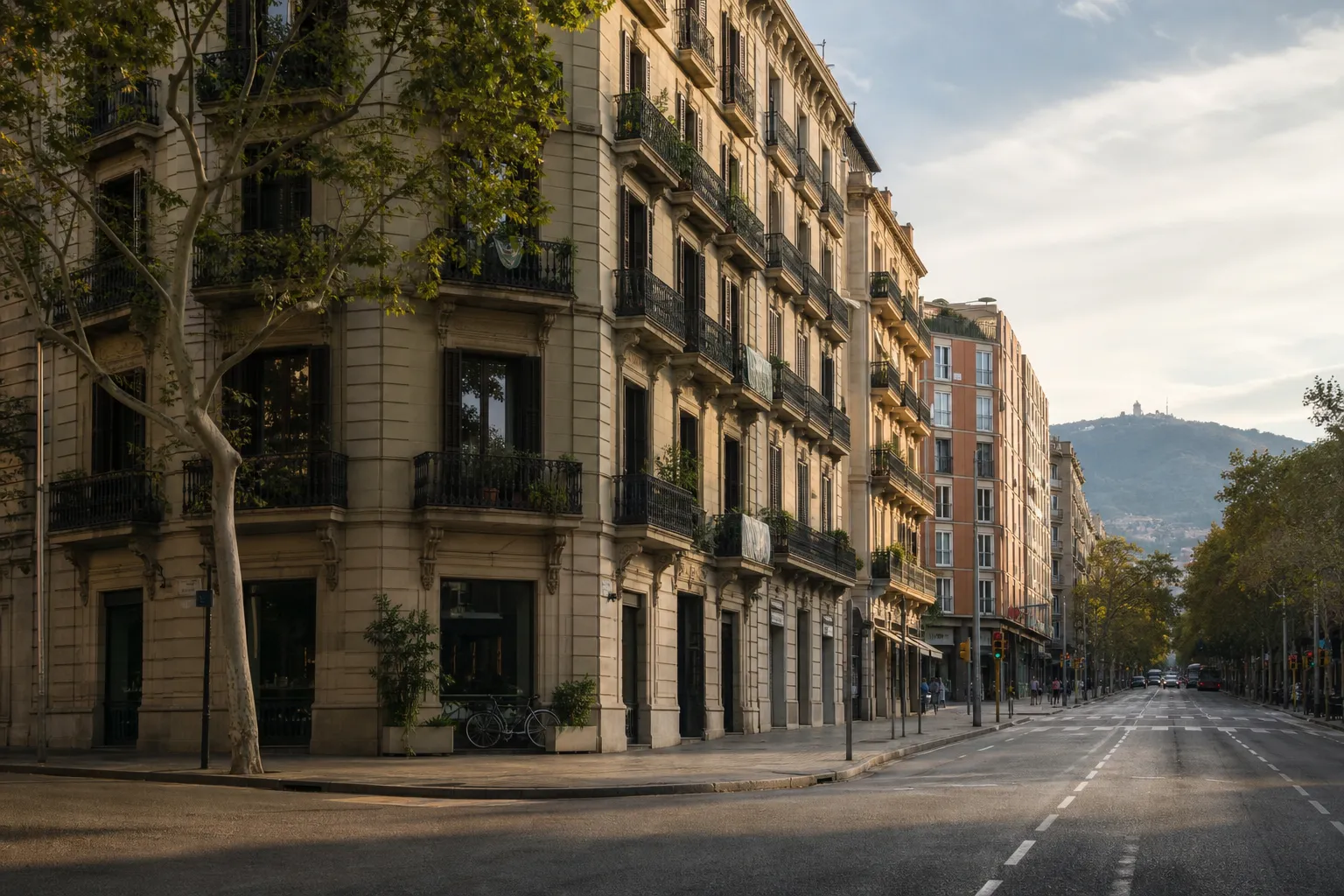
Eixample’s street grid makes the district look consistent from above. At street level, the experience changes quickly. A broad avenue can bring traffic, commerce and visibility. A quieter block can offer a calmer bedroom, but perhaps less light or a less direct route to work. A property facing an inner courtyard can feel detached from the road even when its address sits on a busy corridor.
The municipal commerce plan is useful here because it describes the areas through their actual edges and activity. It places Dreta between Gràcia, the Sagrada Família, Ciutat Vella and Esquerra; it treats Antiga and Nova Esquerra together as Esquerra; and it identifies Sant Antoni as a neighbourhood structured in part by the market around it (Ajuntament de Barcelona commerce plan, neighbourhood boundaries). Those are not valuation bands, but they are a better starting point for a street-by-street search than a single district label.
For a buyer, the four areas can be read as four different briefs:
| Search area | Typical property question | Lifestyle trade-off | Relative price reading |
|---|---|---|---|
| Dreta de l’Eixample | How much character, address value and centrality do I want? | More activity and exposure on prime corridors | Usually the strongest premium for exceptional location and preserved features, but the exact building matters more than the label |
| Esquerra de l’Eixample | Do I want Antiga Esquerra or Nova Esquerra, and how much everyday calm? | More residential routines, with different edges and inner-courtyard options | Broad middle-to-upper Eixample range; renovated, quiet and well-oriented homes can move well above the local baseline |
| Sant Antoni | Is the market-led, social street life a benefit or a source of noise? | Strong daily convenience, with busier ground floors and roads on some edges | Often compared with Esquerra, but block, floor and renovation quality decide the real gap |
| Plaça d’Espanya zone | Do transport links and access to Montjuïc outweigh traffic and scale? | Excellent connectivity, less intimate around the junction itself | Do not use an entire Sants-Montjuïc or Eixample average as a proxy; micro-location is decisive |
The table is a decision framework, not a substitute for comparable sales. The Generalitat’s registered housing statistics track registered transactions and registered sale prices by territorial area, while RICS guidance on comparable evidence stresses that comparables need to be relevant to the property being valued. Neither supports assigning one exact price to every street in an administrative district.
Dreta de l’Eixample: address, architecture and centrality
Dreta is often the first Eixample submarket that international buyers recognise. The reason is easy to understand: the area includes the most visible central avenues and some of Barcelona’s best-known modernist buildings. The municipal profile identifies the neighbourhood’s first open inner block, the Torre de les Aigües, as an example of the hidden courtyards that sit behind the formal street wall (Ajuntament de Barcelona, La Dreta de l’Eixample). The commerce plan also records a high concentration of personal-equipment shops around Passeig de Gràcia, Rambla de Catalunya and the approach to Ciutat Vella (Eixample commerce plan).
That combination creates a recognisable buyer profile. Dreta suits the person who values a central address, a formal façade, generous proportions and immediate access to retail, restaurants and cultural landmarks. It can also suit a buyer who wants a home that remains legible to an international resale audience. Those advantages do not make every property a good purchase. A first floor above a busy commercial frontage and a high floor facing a quiet courtyard may carry the same neighbourhood name but offer different daily lives and different resale audiences.
The building is often the decisive part of the Dreta brief. Buyers should look beyond renovated kitchens and ask what has happened to the façade, roof, lift, communal areas and building services. Original shutters, hydraulic tile, mouldings and balconies can add character, but they can also come with maintenance decisions that belong to the community rather than to one owner. A restored apartment does not automatically mean a restored building.
Dreta also rewards buyers who are honest about sound and privacy. Passeig de Gràcia and the major roads offer a level of connectivity and visibility that many people want. They also carry more pedestrian activity, traffic and commercial movement. An interior-facing flat may solve the sound problem while losing the outlook that justified part of the price. This is where the comparison needs to happen at the window, not in the listing description.
The relative price position is usually strongest when three things meet: an exceptional address, a well-maintained building and a genuinely usable home. It is weaker when the buyer pays a centrality premium for a compromised floor, poor light or expensive communal works. The Idealista June 2026 sales-price report places the whole Eixample district at €6,536 per square metre in its index, but that figure cannot tell you whether a particular Dreta apartment is worth its asking price. For that, the valuer and buyer need comparable homes with similar floor, orientation, condition, size and street exposure.
Esquerra: split the search before you compare homes
“Esquerra” is already a shorthand for two municipal neighbourhoods: L’Antiga Esquerra and La Nova Esquerra. The Ajuntament’s district map lists them separately, and the commerce plan describes their different edges and commercial patterns. Antiga Esquerra borders Dreta, Gràcia, Sarrià-Sant Gervasi and Nova Esquerra; Nova Esquerra extends towards Les Corts and Sants-Montjuïc and meets Sant Antoni at its southern edge (Eixample commerce plan).
That distinction matters to buyers because “Esquerra” can mean a fairly broad range of streets. Antiga Esquerra has a central, established feel and a strong concentration of services, leisure and cultural activity. Nova Esquerra often gives the search more residential depth, with larger inner courtyards and access towards the quieter western side of the district. The city describes some of Nova Esquerra’s inner gardens as among the largest in Eixample (Ajuntament de Barcelona, La Nova Esquerra). That does not make every block quiet, but it explains why courtyard orientation and the exact side of the street matter so much here.
Esquerra is a good fit for buyers who want the Eixample grid without making a prestige address the centre of the brief. The likely priorities are an efficient layout, natural light, a practical walk to work or school, local services and a building with manageable communal costs. Families and full-time residents often care more about bedrooms, storage, lift access and noise at night than about a famous façade. A buyer who works from home may care about the same details, plus the difference between a street-facing study and an interior room.
The property stock is mixed enough to punish shortcuts. One apartment may have retained its original plan and features; another may have been heavily divided, modernised or converted into a more open layout. Renovation quality also varies. A fresh finish can hide poor acoustic separation, inefficient air conditioning or unresolved building issues. Ask for the plans, the building documentation and the history of communal works rather than assuming that a newer-looking interior is the safer option.
Price in Esquerra should therefore be described as a range of relative positions, not a single ranking. A quiet, bright, well-renovated apartment with a lift and a sound building may compete with more expensive-looking homes in Dreta. A dark first floor above an active road can trade at a discount even if the address sounds central. The Generalitat data portal is the correct place to check registered market data at the level it publishes; it does not remove the need to assess the property itself.
Sant Antoni: a neighbourhood organised around daily use
Sant Antoni has a different centre of gravity. The municipal commerce plan says that the Mercat de Sant Antoni structures a concentration of personal-equipment shops around it and that the neighbourhood also has a notable presence of telecommunications businesses along Ronda de Sant Antoni (Eixample commerce plan). The city’s neighbourhood profile also records the Tres Tombs inner-block gardens and local facilities (Ajuntament de Barcelona, Sant Antoni). These details describe a place where the everyday route matters: buying food, meeting friends, walking to a service and getting home without planning a special trip.
That is why Sant Antoni attracts buyers who want an active neighbourhood rather than a purely residential enclave. The market, cafés and streets around the local centre give the area a social rhythm. For some buyers, that is exactly the point. For others, it means more foot traffic, deliveries, restaurant activity or evening noise near the wrong frontage. The same address can feel very different when the bedroom faces a courtyard instead of a commercial street.
The housing stock also makes Sant Antoni a renovation-sensitive submarket. Buyers may find traditional Eixample layouts, updated apartments and buildings close to the boundary with Ciutat Vella or Sants-Montjuïc. The municipal plan places Sant Antoni between Esquerra, Ciutat Vella and Sants-Montjuïc, with a partial boundary towards Dreta (Eixample commerce plan). A few blocks can change the traffic pattern, the commercial mix and the way a home connects to the rest of the city.
Sant Antoni often works for a buyer who wants to live in the home every day and values convenience over ceremony. It can also appeal to a buyer who sees a well-designed renovation as more important than an untouched original interior. The risk is paying for a fashionable address while overlooking practical defects: a low floor without privacy, an apartment above an active venue, limited storage or a building that needs major work.
The price comparison with Esquerra should focus on the home rather than a neighbourhood ranking. Check floor, light, orientation, lift, courtyard, sound and renovation permits. Then compare it with recent or current homes of a similar type. The RICS comparable-evidence guidance supports that method, while the Banco de España paper on mortgage valuation explains why a formal appraisal depends on a defined methodology rather than on a neighbourhood slogan.
The Plaça d’Espanya zone: buy the connection, inspect the edge
Plaça d’Espanya is best treated as a functional search area. The official city description calls it one of Barcelona’s major squares and says it connects Sants, Gran Via, Avinguda del Paral·lel and Montjuïc (Barcelona City Council, Plaça d’Espanya). A municipal mobility study also describes traffic between the Eixample and Sants-Montjuïc districts around the square, including Gran Via, Carrer Tarragona and Avinguda del Paral·lel (Plaça d’Espanya mobility study). The address may be marketed as Eixample, but the experience depends on which side of the junction you occupy.
This zone suits buyers who place a high value on movement. The connection to Sants, the Gran Via, the Paral·lel and Montjuïc can simplify a commute, airport connection or weekend routine. It may also make the area attractive to a buyer who wants access to major events, exhibitions or outdoor space without living in a detached suburban setting. Those benefits come with a more infrastructural feel around the square itself. Wide roads, traffic, noise and larger-scale buildings can matter more than the postal label.
The property brief near Plaça d’Espanya should be precise about the desired radius. A home closer to Nova Esquerra may offer a more conventional Eixample street pattern and a quieter residential pocket. A home nearer the square may trade some intimacy for transport access and views. A property on the Sants-Montjuïc side belongs to a different district and may have different building stock, planning context and resale comparisons. It is not accurate to fold all of those homes into one “Plaça d’Espanya price.”
For the same reason, this is a zone where a viewing should include more than the apartment. Walk the route to the station, stand at the bedroom window at a busy time, check the entrance at night and notice whether the main benefit is actually useful to your life. A transport hub is valuable when you use it. It is a poor reason to pay extra if your daily routine turns away from it.
The Idealista report lists Sants-Montjuïc at €4,552 per square metre in June 2026 and Eixample at €6,536 per square metre. Those figures describe broad district indices, not the homes beside the square. The Generalitat’s registered-price statistics are a separate source with a different basis. Treat both as context, then return to the street and the building.
What the 2026 price data can and cannot tell you
The headline number is useful if it is kept in its lane. Idealista’s June 2026 report lists Barcelona at €5,269 per square metre and Eixample at €6,536 per square metre, with Eixample’s index up 5.2% year on year. The same table lists Sants-Montjuïc at €4,552 per square metre, up 4.7% year on year (Idealista price report, June 2026). These are broad index figures. They are not registered prices for each property and do not divide Eixample into Dreta, Antiga Esquerra, Nova Esquerra and Sant Antoni.
The Generalitat describes its own housing statistics as a quarterly and annual follow-up of registered transactions and registered sale prices, broken down by territorial areas, counties and municipalities (Generalitat housing statistics). That makes it valuable for checking the market against an asking-price index, but it still does not turn a district average into a property valuation.
For a buyer, the practical conclusion is simple: use the public numbers to set expectations, not to skip the comparable analysis. A price difference between two flats may be explained by floor, light, lift, terrace, orientation, internal courtyard, building works, energy performance or the legality and quality of a renovation. The RICS guidance describes comparable evidence as something that should be relevant to the property, while the Banco de España research paper sets out the role of standards in Spain’s appraisal system.
This is also the reason to be careful with language such as “the cheapest part of Eixample” or “the most expensive neighbourhood.” Those phrases may be directionally useful in a first search, but they become misleading when they hide the difference between a bright, renovated, upper-floor home and a darker, noisy, lower-floor home on the same broad market. Relative price is a starting hypothesis. The property file and the building inspection test it.
How to choose between the four areas
Start with your daily life, then let the address narrow the search. If architecture, centrality and a formal address lead the brief, begin with Dreta. If you want the grid and services but a more residential routine, compare Antiga Esquerra with Nova Esquerra instead of treating Esquerra as one block. If a market-led social neighbourhood matters, include Sant Antoni. If commuting and access to Montjuïc or Sants dominate, test the Plaça d’Espanya zone while accepting that the urban edge will feel more exposed.
Next, decide which compromises are real compromises for you. Some buyers will trade a bedroom or a terrace for a preserved façade. Others will trade a famous address for a lift, quiet courtyard and better layout. A family may value a second bathroom and storage above a shop-lined avenue. A buyer who spends little time at home may prefer a central location and accept activity at street level. There is no universal ranking here, only a different order of priorities.
Then compare the building before comparing the decoration. Ask for the latest community meeting minutes, planned works, lift history, façade or roof projects and the building’s technical documentation. Ask whether the apartment’s current layout matches the approved plans and whether any renovation needs community or municipal permission. The Agència de l’Habitatge de Catalunya guidance on ITE is a useful reminder that technical condition belongs in the purchase conversation.
Finally, keep price and resale connected without turning the decision into an investment promise. A property with a broad future audience may be easier to resell, but audience size does not fix overpayment or a bad floor. A highly specific home can be right for the owner and slower to sell later. The Generalitat’s registered data and professional comparable guidance support a disciplined comparison; they do not predict an individual exit.
A street-level checklist for an Eixample viewing
Before making an offer, test the submarket and the apartment together. A useful viewing sequence is:
- Walk the block in the morning and again in the evening. Listen for traffic, loading, hospitality activity and recurring noise.
- Stand in every main room and record the direction of the windows. Separate street light from courtyard light; both can be useful, but they are not the same.
- Inspect the entrance, lift, stairs, façade and common areas. A beautifully renovated apartment sits inside a building with its own maintenance history.
- Ask what the community has approved, discussed or deferred. Roofs, façades, lifts, waterproofing and structural work can change the cost of ownership.
- Compare the floor plan with the actual apartment. Pay attention to enclosed balconies, divided rooms, storage and any work that may require documentation.
- Test the route that made you choose the area. Walk to the market in Sant Antoni, Passeig de Gràcia in Dreta, the inner streets of Esquerra or the station and Montjuïc from Plaça d’Espanya.
- Build a comparable set with similar size, floor, orientation, building condition and renovation level. Do not compare a courtyard-facing renovated home with a street-facing project simply because both are in Eixample.
The process is deliberately less glamorous than choosing a neighbourhood from a guide. That is a feature, not a flaw. RICS comparable-evidence guidance and the Banco de España paper on valuation standards both point towards structured evidence. The Notariado’s general buying guidance is also useful before you sign or pay, because the decision needs legal and documentary checks as well as a lifestyle fit.
How Lasose can help you choose the right micro-location
Lasose can help buyers turn a broad Eixample request into a short list that is specific enough to act on. That means clarifying the purpose of the purchase, separating non-negotiables from preferences, and deciding whether the search should include the edges between neighbourhoods. A buyer who says “Eixample” may really mean a quiet courtyard near Sant Antoni, a preserved apartment in Dreta or a well-connected home near Plaça d’Espanya. Those are different searches and should be treated that way.
Before making an offer, combine the local comparison with the Notariado’s buying guidance and RICS guidance on comparable evidence. They cover different parts of the decision, but both help keep a shortlist grounded in evidence.
The next step is to compare homes on the same terms. Lasose can organise the search around building condition, light, sound, layout, location and relative price rather than forwarding every listing that contains the word Eixample. When a property is worth serious consideration, the buyer should still use qualified legal, technical and valuation professionals for the relevant checks. Agency guidance does not replace those roles.
If you are deciding between Dreta, Esquerra, Sant Antoni and Plaça d’Espanya, send Lasose your budget, intended use, preferred lifestyle and the compromises you will accept. The result should be a focused shortlist, not a district-wide catalogue. You can also start with Lasose’s Barcelona property listings and read the 2026 guide to buying property in Barcelona as a foreigner if the purchase involves an international buyer.
The right Eixample purchase is rarely the one with the broadest neighbourhood label. It is the one whose street, building and daily routine still make sense after the first viewing has worn off.