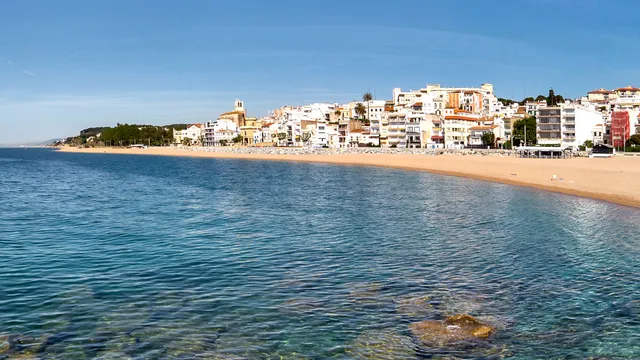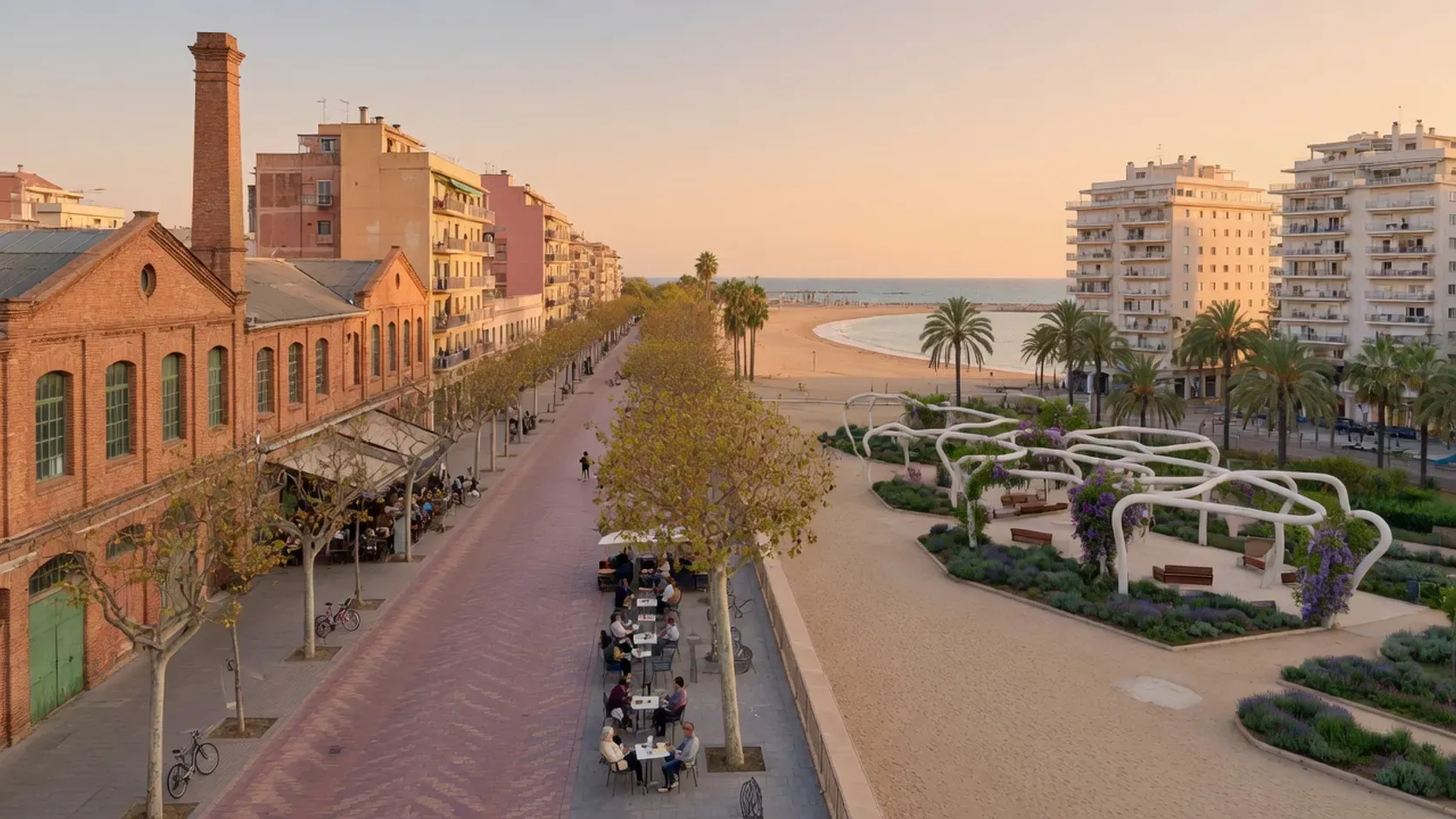
Poblenou and Diagonal Mar are neighbouring choices inside Barcelona’s Sant Martí district, not two names for the same barri (Els barris | Sant Martí). Officially, El Poblenou and Diagonal Mar i el Front Marítim del Poblenou are separate neighbourhoods. The City Council describes Poblenou as extending from Avinguda Diagonal to the sea, and Diagonal Mar as the city’s newest neighbourhood, still in formation and consolidation. For a primary-home buyer, start with that membership fact, then decide whether you want street-city fabric or park-and-beach managed living before you fall for a listing label.
Membership is only the starting filter. The wrong loft near Rambla del Poblenou, or the wrong stack facing a busy park edge, will still be the wrong home. Treat this page the way the Eixample Dreta versus Esquerra buying guide treats three Eixample labels: as a frame for weekday life, then bring every shortlist item back to the exact street, rooms and building papers.
This article is for an owner-occupier or relocator buying a primary home. If you are weighing a weekend base instead, use the separate Barcelona, Sitges and Garraf second-home comparison. The evidence here comes from municipal neighbourhood, park, beach, planning and works pages, plus Land Registry, Cadastre, notarial and Catalan ITE guidance. It is orientation, not legal advice, a price guide, a view guarantee or a school-place promise.
Choose the weekday before you choose the neighbourhood name
A viewing often happens when the flat looks its calmest. Your week will not. Write the journeys that will repeat before you argue about neighbourhood names: front door to desk, front door to school or nursery drop-off if that applies, the food shop on the way home, an evening appointment, a late return, and any trip made with luggage or limited mobility.
Use addresses rather than pins labelled “Poblenou” or “Diagonal Mar”. TMB’s journey planner calculates options from an entered origin and destination and lets you set a departure or arrival time. A route that looks short on a coloured metro diagram can still include a long walk, an awkward interchange or a final block you dislike after dark.
On this corridor, TMB’s metro line L4 lists El Maresme | Fòrum, Selva de Mar, Poblenou, Llacuna and Bogatell among the stations serving the Sant Martí / Poblenou seafront strip. Station presence is not a door-to-door time. Measure the last metres from the candidate entrance, then run the same timed search for each serious address.
The Sant Martí beaches page also notes that the seafront is reachable by multiple bus lines and Bicing stops, and that in the Diagonal Mar area beaches can be reached by tram and metro (Sant Martí seafront beaches). Mode availability is useful context. It does not replace the address-level planner test at the hours you would really travel.
Use three timed checks for each shortlisted home:
- Search the morning route at the time you would leave, including the walk from the front door.
- Search the return at the time you normally finish.
- Walk the last block once in daylight and once after dark. Note crossings, pavement width, station entrances, shade and any works fencing.
If the weekday fails, the brochure will not fix it.
Two official neighbourhoods in Sant Martí
Sant Martí is an official Barcelona district with ten neighbourhoods, including El Poblenou and Diagonal Mar i el Front Marítim del Poblenou. The City’s district page lists them as separate barris, not as interchangeable marketing labels (Els barris | Sant Martí).
The City Council describes El Poblenou as extending from Avinguda Diagonal to the sea, and notes that industrial and residential activities used to be combined there. That mixed history still shows in the street fabric many buyers walk: workshops beside flats, converted industrial shells, ordinary mid-rise blocks and active ground-floor uses. It does not mean every street feels the same after 11 p.m.
The City Council describes Diagonal Mar i el Front Marítim del Poblenou as the newest neighbourhood in the city and says it is still in a process of formation and consolidation. Read that as a municipal characterisation of a younger urban piece, not as a quality certificate for any particular tower, garden block or seafront stack. The same district page is the membership source for both neighbourhoods (Sant Martí neighbourhoods).
Keep the other Sant Martí names in the background when a listing blurs edges: Vila Olímpica del Poblenou, Provençals del Poblenou, El Parc i la Llacuna del Poblenou, and Besòs i el Maresme sit nearby. A primary-home search should name the official barri of the candidate address, then test the street.
Poblenou: street-city fabric, Rambla and the 22@ planning layer
Prefer a Poblenou street-city search when you want mixed frontages, shorter walks between everyday errands and a fabric shaped by industrial-residential history. The municipal history of El Poblenou states that the 1992 Olympic Games started a major transformation of the neighbourhood, and that the 22@ project today is developing on both sides of the traditional Poblenou core (Història del Poblenou).
That history explains why a loft conversion, a renovated street-block flat and a newer mid-rise can sit a few minutes apart. It does not tell you which of those building types matches your week. Walk Rambla del Poblenou and the side streets you would actually use for groceries, school runs or evening returns. Listen at the bedroom window, not just from the café terrace.
22@ is planning context, not a buyable neighbourhood brand. Barcelona City Council states that the MPGM 22@2022 area is located in Sant Martí, does not correspond to any neighbourhood delimitation, and is formed by parts of Parc i la Llacuna del Poblenou, Poblenou, Provençals del Poblenou, Diagonal-Mar and Marítim del Poblenou, and Besòs i el Maresme (MPGM 22@ participation page). If a listing says “22@ loft”, treat the phrase as a prompt to check the exact address, use and conversion papers. For loft legality, habitability and conversion questions, use the dedicated Poblenou loft resource rather than stretching this neighbourhood comparison into a legal guide.
Poblenou usually fits a buyer who:
- wants street-level errands and mixed frontages as part of the home;
- accepts that Rambla del Poblenou and quieter side streets are different products;
- is willing to reject a striking interior when the building file or sleeping side fails.
It disappoints when buyers chase a loft look without checking conversion papers, or when they assume every address near Bogatell beach will feel like a quiet courtyard.
Diagonal Mar: park, beach assignment and large housing blocks
Prefer a Diagonal Mar or Front Marítim search when a major park, assigned beaches and large housing blocks match a more managed day. The municipal history of Diagonal Mar i el Front Marítim del Poblenou describes the central Diagonal Mar sector as including large housing blocks, a shopping centre and the Miralles-designed park, and describes the Front Marítim sector as five housing blocks with central gardens (Diagonal Mar neighbourhood history).
Barcelona City Council’s park fiche states that Parc de Diagonal Mar is Barcelona’s second-largest park and is located in the neighbourhood Diagonal Mar i el Front Marítim del Poblenou in the district of Sant Martí. The same fiche attributes more than 340,000 m² to the mixed-use Diagonal Mar area—residential buildings, offices, a shopping centre, hotels and the park—bounded by Carrer de Llull, Carrer de Josep Pla, Carrer de la Selva de Mar, Parc Lineal Garcia Fària and the final section of Avinguda Diagonal, while a May 2024 Sant Martí municipal notice records that the park was inaugurated in 2002 on a surface of 14 hectares (Parc de Diagonal Mar; Sant Martí park walkway update).
Those facts support a daily-life comparison. They do not prove that every nearby apartment is quiet, that a park outlook lasts, or that community systems in a tall building will be cheap to run. For tower orientation, community systems and coastal due diligence, keep the handoff short and use the dedicated Diagonal Mar home resource.
Diagonal Mar often suits a buyer who:
- wants park and beach access as a repeated weekday or weekend pattern;
- prefers larger, more managed housing blocks over mixed industrial-street fabric;
- will still visit the exact stack at living hours and read the community file.
It is a weaker fit when you want café-street life outside the door every evening, or when you are not ready to inspect lifts, façades, reserves and coastal works notices with the same seriousness you give the view from the terrace.
Building type: loft, mid-rise street block or amenity high-rise
Choose by building type and routine, not by brochure geography (Diagonal Mar neighbourhood history; Poblenou history). Prefer a Poblenou street-city search when you want mixed frontages, shorter walks between everyday errands and a fabric shaped by industrial-residential history and the later 22@ planning layer around the traditional core. Prefer a Diagonal Mar or Front Marítim search when the municipal morphology of large housing blocks, a major park, shopping centre and central gardens matches a more managed, park-beach day. Keep a loft or an amenity high-rise on the shortlist only if you are ready for the separate due-diligence pages those building types need; otherwise compare ordinary mid-rise blocks first. Morphology cues come from the Diagonal Mar neighbourhood history and the Poblenou history.
Use three editorial types as comparison axes, not as municipal labels:
| Test | Loft / converted industrial character | Mid-rise street block | Amenity high-rise / managed block |
|---|---|---|---|
| Weekday errands | Strong if the street still works on foot | Often the simplest everyday fabric | Depends on the walk to shops and stations |
| Sleeping side | Check courtyard, street and neighbouring uses | Compare street versus interior rooms | Check park edge, traffic edge and neighbour stacks |
| Documents | Conversion, use and habitability need extra care | Ordinary title and community papers still matter | Community systems, reserves and coastal works matter |
| Handoff | Poblenou loft resource | Stay on this page’s street tests | Diagonal Mar home resource |
The Poblenou history page and the Diagonal Mar history page are the morphology sources behind that table (Poblenou history; Diagonal Mar history). Shortlist one real candidate of each type only when your brief truly spans them. Otherwise pick the type that matches the week, then compare two or three addresses inside that type at the same all-in budget.
Beach, park and Mar Bella works through spring 2027
Municipal sources pin the outdoor anchors rather than lifestyle adjectives. Parc de Diagonal Mar is Barcelona’s second-largest park in Diagonal Mar i el Front Marítim del Poblenou; the park fiche’s “over 340,000 m²” figure describes the wider mixed-use Diagonal Mar area, while a May 2024 Sant Martí municipal notice records that the park was inaugurated in 2002 on a surface of 14 hectares (Parc de Diagonal Mar; Sant Martí park walkway update). Along Sant Martí’s roughly 2,500-metre shoreline, Bogatell is assigned to El Poblenou, while Mar Bella, Nova Mar Bella and Llevant are assigned to Diagonal Mar; Bogatell itself is recorded at about 702 metres between the Bogatell and Mar Bella breakwaters (Sant Martí beaches; Platja del Bogatell). Those placements support a daily-life comparison; they do not prove that every nearby apartment is quiet or has a lasting view.
The City Council states that Sant Martí’s roughly 2,500-metre shoreline has five beaches: Nova Icària in Vila Olímpica del Poblenou; Bogatell in El Poblenou; and Mar Bella, Nova Mar Bella and Llevant in Diagonal Mar i el Front Marítim del Poblenou, plus the sand-free Forum bathing area in Besòs i el Maresme (Sant Martí beaches). The municipal Bogatell beach page places the beach in Sant Martí, records a length of about 702 metres, and situates it between the Bogatell and Mar Bella breakwaters (Platja del Bogatell).
Seafront amenity claims also need a works check. A May 2025 City Council notice states that reurbanisation works on Passeig de la Mar Bella are under way, are expected to continue until spring 2027, and occupy the Passeig Marítim del Bogatell perimeter between Carrer de Bac de Roda and Carrer de la Selva de Mar while maintaining pedestrian crossings to Nova Mar Bella beach (Mar Bella promenade works notice). Programmes can change. Verify current site notices before treating spring 2027 as fixed, and walk the access you would use with children, luggage or a bicycle.
Park proximity deserves the same honesty. The Diagonal Mar park fiche is strong evidence for size and mixed surroundings. It is not a silence certificate for a street-facing bedroom on Llull, Josep Pla or Selva de Mar.
Noise and coexistence on Rambla del Poblenou
Do not buy a neighbourhood name as a promise of quiet. Visit the rooms you would sleep and work in at the hours that matter to you.
In December 2025 the City Council approved a special urban plan for Sant Martí that keeps limits on new nightlife and restaurant openings in an Área de Tratamiento Especial covering the Triángulo Lúdico and Rambla del Poblenou, and extends that ATE to Carrer de Rogent, citing coexistence problems linked to night-time concentration of public-concurrence premises (Sant Martí Pla d’usos news). The plan regulates new openings. It does not certify that a specific address is quiet, and existing premises remain a visit-time question.
Three limits keep the comparison honest. First, 22@ is a Sant Martí planning area that the City says does not follow neighbourhood boundaries, so “buying in 22@” is not a neighbourhood decision (MPGM 22@ participation page). Second, Rambla del Poblenou sits inside a special uses-plan area where the City has limited new nightlife and restaurant openings because of night-time coexistence pressure. That regulates new openings; it does not certify silence at a given address (Sant Martí Pla d’usos news). Third, Mar Bella promenade works were officially described in May 2025 as running towards spring 2027 between Bac de Roda and Selva de Mar, so seafront access and amenity claims must be checked against current site notices (Mar Bella promenade works notice). This page orients daily life and building type; it is not legal advice, a price guide, a view guarantee or a school-place promise.
Cross-check those limits against the 22@ planning page and the Mar Bella works notice when a listing leans hard on “quiet park living” or “22@ lifestyle”.
Documents before the offer
Use the same sequence for both neighbourhoods. First, put the exact address into TMB’s journey planner at the hours you would really travel, and note that L4 stations on this corridor include Selva de Mar, Poblenou, Llacuna, Bogatell and El Maresme | Fòrum, while the City also notes tram and metro access in the Diagonal Mar beach area (Sant Martí beaches). Second, visit the rooms you would sleep and work in, rather than only the park or beach edge. Third, before any binding offer, obtain current Land Registry information, reconcile Cadastre and the physical plan, and review building papers including any applicable Catalan ITE; the Generalitat describes the ITE as a visual inspection that is not meant to detect hidden defects (Generalitat ITE FAQs), and the notary’s later completion checks do not replace early adviser time (Notariado housing guidance).
Run the papers before enthusiasm narrows your options:
- Obtain current Land Registry information. The Colegio de Registradores states that a Land Registry Excerpt identifies the property, ownership, rights and surface/nature/boundaries, and is solely for informational purposes; only a Registry certificate proves the content of Registry entries for third-party enforcement (Land Registry guidance).
- Match Registry data against the deed, cadastral reference and physical plan. The Spanish Cadastre electronic office provides cadastral certificate routes, including descriptive and graphic certificates for a property, through its authenticated access assistant (Catastro certificates). Matching street addresses do not prove that all areas and alterations agree.
- Review the community file and building condition, including any applicable ITE. The Generalitat describes the Catalan ITE as a visual inspection of a residential building by a competent technician to determine its condition at the time of inspection; it is not intended to detect hidden defects (Generalitat ITE FAQs).
- Give independent legal and technical advisers time before any binding deposit. The Consejo General del Notariado explains that, in a home purchase, the notary requests prior Registry information, checks evidence that community fees have been paid, requests the cadastral reference and descriptive/graphic cadastral certificate, and notes discrepancies among cadastral, deed and Registry data; where the autonomous community requires it, the notary also checks the habitability certificate (Notariado housing guidance). Those completion controls do not make a rushed private offer harmless.
For a focused paper list, use the pre-offer property documents checklist. Location does not cure a mismatch between the apartment you saw and the property being sold.
Compare three real homes, then contact
Once the brief is clear, stop arguing about labels. Choose one real Poblenou candidate and one real Diagonal Mar or Front Marítim candidate at roughly the same all-in budget. If your brief spans building types, add a third home so loft, mid-rise and amenity high-rise are not argued in the abstract. Visit them with the same routine sheet. Run each address through the TMB journey planner on an identical day and time.
Record four facts before you discuss how a flat “feels”:
- door-to-destination time for the repeated morning and evening journeys, using the L4 station list only as a starting map;
- sound at the bedroom and living-room windows at two relevant times, including any Rambla or park-edge activity;
- furniture-ready room dimensions and usable storage;
- known building works, unresolved document differences and cash needed after completion, with the Notariado purchase checks kept in view as later completion controls rather than a reason to rush the deposit.
Then state the sacrifice in one sentence. “Poblenou keeps my errands on foot, but the sleeping side faces an active frontage.” “Diagonal Mar gives us the park loop, but the community file shows major façade work.” If you cannot name the sacrifice, the comparison is still too vague.
Browse current Sant Martí homes for sale only after writing that routine. Contact Lasose with the repeated journeys, minimum usable rooms, light and noise limits, preferred building type and the compromise you will not make. Keep lifestyle notes separate from the questions for your lawyer, tax adviser and building professional.
Frequently Asked Questions
Are Poblenou and Diagonal Mar the same neighbourhood?
No. Both sit in the district of Sant Martí, but they are separate official neighbourhoods: El Poblenou and Diagonal Mar i el Front Marítim del Poblenou. The City Council describes Poblenou as running from Avinguda Diagonal to the sea, and Diagonal Mar as the city’s newest neighbourhood, still consolidating. Treat the labels as different daily-life starting points, then compare the exact street and building.
Does living near Diagonal Mar Park or the beach guarantee a quiet home?
No. Parc de Diagonal Mar is Barcelona’s second-largest park and the Sant Martí seafront assigns Bogatell to Poblenou and Mar Bella / Nova Mar Bella / Llevant to Diagonal Mar, but park or beach proximity is not a silence certificate. Street edges, mixed uses around the park, coastal works and night-time premises can change the experience. Visit the candidate at the hours you would actually be home, and check current works notices for the Mar Bella promenade.
Is 22@ a neighbourhood I can buy into?
Not as a neighbourhood boundary. Barcelona City Council states that the 22@ planning area is in Sant Martí, does not match any neighbourhood delimitation, and covers parts of several neighbourhoods including Poblenou and Diagonal Mar. Use 22@ as planning context for the exact address. For loft-style conversions, hand off to the dedicated Poblenou loft resource rather than treating “22@ loft” as a legal status.
Which building type should an owner-occupier compare first?
Compare the building type against your daily routine, not against a neighbourhood slogan. Poblenou’s traditional core grew as mixed industrial-residential fabric and still rewards street-level testing; Diagonal Mar’s municipal history describes large housing blocks with a park and shopping centre, and Front Marítim blocks with central gardens. A loft needs a separate legality and conversion check; a managed high-rise needs a separate community-systems check. Shortlist one real candidate of each type at the same all-in budget, then keep the winner only if the commute, rooms and documents also work.
What should I check before making an offer in Sant Martí?
The checklist depends on the home and building, but the documentary sequence is the same across Poblenou and Diagonal Mar. Use current Land Registry information (an excerpt is informational; a certificate has stronger evidentiary status), reconcile Cadastre, the deed and the physical plan, review community papers and any applicable ITE, and give independent advisers time before a binding deposit. Catalonia’s ITE is a visual building inspection and is not meant to find hidden defects. Completion controls by a notary do not make a rushed private offer harmless.